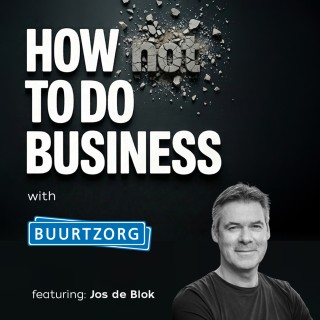
S01:E05
A patient in a fragmented home care system can have twenty or thirty different people come through the front door in a month, each delivering one timed task from a list. Buurtzorg sends one nurse, who does whatever that person needs – and whose job includes teaching them to need less of it.
That inversion is the model. Jos de Blok started it in 2006 with a single team and nobody above them. It now runs around nine hundred teams of ten to twelve nurses, who hire their own colleagues, run their own rounds and split in two when they outgrow the neighbourhood. There are still no managers. The first objection it met was that nurses qualified to work that way would cost more – what happened instead was that doctors started sending Buurtzorg the most complex patients they had, because they trusted the nurses with them.
Changing the Narrative is independent and has no advertisers and no sponsors to ensure that remains so. Paid membership is what helps sustain the work we do and help change the narrative at a time when it’s needed most -https://changingthenarrative.media/support
In this episode
• How home care was reorganised into billable products and tasks, and why that left patients more dependent rather than less
• What a Buurtzorg team actually is: ten to twelve nurses, one neighbourhood, no manager
• Why Jos argues that doing the right thing costs the system less rather than more
• The two objections the model met first – that higher-qualified nurses would be more expensive, and that it only took the simple cases
• Growth without marketing, and teams that split like cells once they reach twelve
• April 2016, when around 2,400 domestic care workers moved across and left their managers behind
• What happens when a team can’t resolve something on its own, and where the coaches come in
• Taking the model abroad – Taiwan, China and the turn towards primary care – and what “humanity over bureaucracy” means in practice
About the guest
Jos de Blok is the founder of Buurtzorg and a community nurse by training. He started a business-school degree, left it, and qualified as a nurse instead, working as a nurse for fourteen years before moving into management as a director in Dutch home care. He founded Buurtzorg in 2006 with a single team; it now runs around nine hundred neighbourhood nursing teams with no managers, alongside arms for mental health (Buurtzorg T), youth care (Buurtzorg Jong) and domestic care, and he puts its turnover at around €600 million.
Links mentioned in this episode Buurtzorg (Almelo, Netherlands), the neighbourhood nursing organisation Jos founded in 2006: https://www.buurtzorgnederland.com/
Buurtzorg International, which supports the model outside the Netherlands: https://www.buurtzorg.com/
Buurtzorg in Taiwan, the partner organisation marking its tenth year: https://www.buurtzorg.com/buurtzorg-in-taiwan/
The World Health Organization on primary health care: https://www.who.int/health-topics/primary-health-care
Full show notes and the archive: https://content.changingthenarrative.media/corporation-tax-how-you-know-if-a-company-is-good-or-bad-regardless-of-its-size
Chapters
00:00 Introduction
02:13 Meeting Jos: from business school to the nursing round
03:14 Why he built something different: care going “industrial”
06:33 When care became a product: fragmentation and dependency
10:10 The first steps: a model with every answer, and a five-year plan
12:19 What Buurtzorg is: neighbourhood nursing, and how a team runs
15:56 Why self-organisation: trust, autonomy and learning from experience
20:34 Overcoming resistance: “it’ll cost more” and “only the simple cases”
26:53 A €600m organisation on a strikingly simple financial system
27:05 Growth without marketing: teams that split like cells
29:36 The 2016 takeover: 2,400 workers leave their managers behind
32:19 When teams struggle: coaches and the “self-cleaning” process
35:53 Going global: Taiwan, China and the turn to primary care
39:44 Can it work anywhere? Demography, prevention and the WHO
42:45 The takeaway: humanity over bureaucracy
43:45 Closing reflections and outro